Home / Harley-Davidson / Breakout
Harley-Davidson · Power cruiser · M-8 117 Custom
2026 Harley-Davidson Breakout: specs, gearing and calculators
Long, low and raked out: a 21-inch front, a 240 mm rear tyre, 34 degrees of rake and the Milwaukee-Eight 117 Custom. Every figure below links to its source, and every calculator opens with the Breakout’s own numbers.
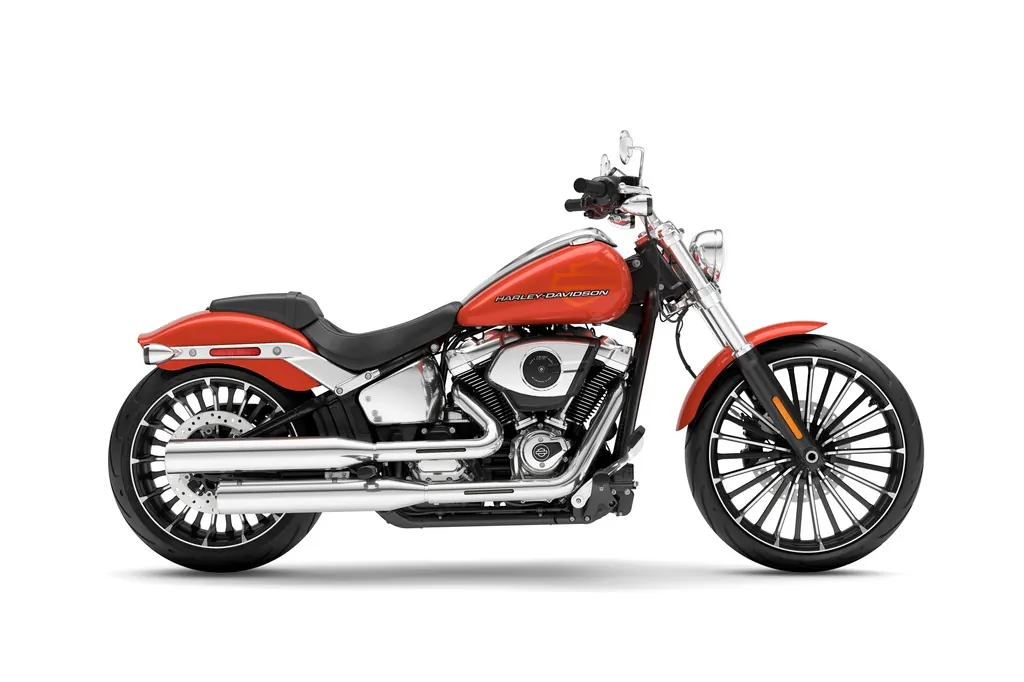
Know your version. The Breakout returned for 2023 with the Milwaukee-Eight 117. Earlier Breakouts (Twin Cam engines from 2013, then the Milwaukee-Eight 107 or 114 from 2018) have different engines and figures. EU spec sheets list 168 Nm of torque; the US figure of 126 lb-ft (171 Nm) uses a different test method.
MotoWild Lab
Calculators with the Breakout’s numbers filled in
Each one opens with the published figures for the 2026 Breakout: the Milwaukee-Eight 117’s bore and stroke, the gear ratios, belt pulleys, tyre sizes, rake and weight. Change any number to match your bike, see the formula worked through, and switch between imperial and metric.
2026 Breakout specifications
Figures as published, with the sources underneath. Power and torque are Harley-Davidson’s US ratings; seat height is laden (with a rider aboard) unless stated.
| Spec | 2026 Harley-Davidson Breakout |
|---|---|
| Engine | Milwaukee-Eight 117 Custom, 1,923 cc (117 cu in) 45° V-twin |
| Power (claimed) | 103 hp (77 kW) at 4,800 rpm |
| Torque (claimed) | 126 lb-ft (171 N·m) at 3,000 rpm |
| Bore × stroke | 103.5 × 114.3 mm (4.075 × 4.5 in) |
| Compression ratio | 10.3:1 |
| Weight | 681 lb (309 kg) in running order |
| Seat height | 25.6 in (650 mm) laden; 26.2 in (665 mm) unladen |
| Fuel tank | 5 US gal (18.9 L), including about 1 gal (3.8 L) reserve |
| Rake / trail | 34° / 5.7 in (145 mm) |
| Wheelbase | 66.7 in (1694 mm) |
| Wheels | Cast 21 / 18 in |
| Transmission | 6-speed; primary chain 34/46, final belt 32/66 |
| Gear ratios (overall) | 9.311 / 6.454 / 4.793 / 3.882 / 3.307 / 2.79 |
| US price | $22,999 (starting MSRP) |
| Ground clearance | 4.5 in (114 mm) |
Sources: motorcycle.com · totalmotorcycle.com · aeharley.com · bartelsharley.com · harley-davidson.com · riders-share.com. Where sources disagree we show the range.
Gearing
Breakout gear ratios and road speed in every gear
Six speeds, a 34/46 primary chain and a 32/66 final belt. The table works the published overall ratios back to the gearbox ratios and gives road speed at three engine speeds.
| Gear | Gearbox ratio | Overall ratio | At 2,000 rpm | At 3,000 rpm | At 4,000 rpm |
|---|---|---|---|---|---|
| 1 | 3.337 | 9.311 | 16 mph 26 km/h | 25 mph 39 km/h | 33 mph 53 km/h |
| 2 | 2.313 | 6.454 | 24 mph 38 km/h | 35 mph 57 km/h | 47 mph 76 km/h |
| 3 | 1.718 | 4.793 | 32 mph 51 km/h | 48 mph 77 km/h | 63 mph 102 km/h |
| 4 | 1.391 | 3.882 | 39 mph 63 km/h | 59 mph 95 km/h | 78 mph 126 km/h |
| 5 | 1.185 | 3.307 | 46 mph 74 km/h | 69 mph 111 km/h | 92 mph 148 km/h |
| 6 | 1.000 | 2.790 | 55 mph 88 km/h | 82 mph 132 km/h | 109 mph 175 km/h |
In 6th: 60 mph: 2,200 rpm · 70 mph: 2,570 rpm · 80 mph: 2,940 rpm
Gearbox ratios are the published overall ratios divided by the primary (46/34) and belt (66/32) ratios. Speeds use the rear tyre's unloaded circumference (2,040 mm); under load it rolls a few percent shorter, so real rpm is slightly higher. Published overall ratios: aeharley.com.
Tyres and wheels
Stock tyre sizes
Confirm against the sidewalls on your bike and the owner’s manual, including the load index, speed rating and whether the tyre is bias (B) or radial (R).
| Version and years | Front | Rear | Rims | Source |
|---|---|---|---|---|
| Harley-Davidson Breakout 2026 | 130/60B21 | 240/40R18 | Cast 21 / 18 in | motorcycle.com |
Side by side
Breakout vs Fat Boy
The same figures for both, on the same basis.
Head-to-head · MotoWild data

- Ready to ride, the 2026 Harley-Davidson Breakout is the lightest here, roughly 6 kg (13 lb) less than the 2026 Harley-Davidson Fat Boy. Makers weigh differently, so treat small gaps as a draw.
Seat height (laden, as published)
A range means sources disagree. Lower is easier at a stop, but weight and seat width matter too.
Weight, ready to ride
Figures as published, with their basis. Wet, kerb and full-tank weights are close but not identical, so a few kilos either way is a draw.
Fuel tank
| Spec | 2026 Harley-Davidson Breakout | 2026 Harley-Davidson Fat Boy |
|---|---|---|
| Engine | Milwaukee-Eight 117 Custom, 1,923 cc (117 cu in) 45° V-twin | Milwaukee-Eight 117 Custom, 1,923 cc (117 cu in) 45° V-twin |
| Power (claimed) | 103 hp (77 kW) at 4,800 rpm | 103 hp (77 kW) at 4,800 rpm |
| Torque (claimed) | 126 lb-ft (171 N·m) at 3,000 rpm | 126 lb-ft (171 N·m) at 3,000 rpm |
| Weight | 681 lb (309 kg) in running order | 694 lb (315 kg) in running order |
| Seat height | 25.6 in (650 mm) laden; 26.2 in (665 mm) unladen | 25.9 in (658 mm) laden; 675 mm unladen |
| Fuel tank | 5 US gal (18.9 L), including about 1 gal (3.8 L) reserve | 5 US gal (18.9 L), including about 1 gal (3.8 L) reserve |
| Rake / trail | 34° / 5.7 in (145 mm) | 30° / 4.1 in (104 mm) |
| Wheelbase | 66.7 in (1694 mm) | 65.0 in (1651 mm) |
| US price | $22,999 (starting MSRP) | $22,599 (starting MSRP) |
| Tyres | 130/60B21 / 240/40R18 Cast 21 / 18 in | 160/60R18 / 240/40R18 Cast 18 / 18 in |
Versions and model years
- Harley-Davidson Breakout: The Breakout returned for 2023 with the Milwaukee-Eight 117. Earlier Breakouts (Twin Cam engines from 2013, then the Milwaukee-Eight 107 or 114 from 2018) have different engines and figures. EU spec sheets list 168 Nm of torque; the US figure of 126 lb-ft (171 Nm) uses a different test method.
- Harley-Davidson Fat Boy: Fat Boys have used the Evolution, Twin Cam and Milwaukee-Eight engines since 1990. These figures are for the 2026 bike with the 117 Custom; check your model year before using them for parts or settings.
Figures: motorcycle.com · totalmotorcycle.com · aeharley.com · bartelsharley.com · harley-davidson.com · riders-share.com · motorcycle.com · totalmotorcycle.com · torquepedia.com · harleydavidsonofsaltlakecity.com · harley-davidson.com.
Model history
Which Breakout do you have?
Engines and frames have changed over the years, so older bikes have different figures.
- 2013
First Breakout
The Breakout joins the Softail family with a 21-inch front and wide rear tyre. [src]
- 2018
New Softail chassis
The Softail range moves to a new frame with the Milwaukee-Eight engine. [src]
- 2026
Current model
Milwaukee-Eight 117 Custom, 103 hp and 126 lb-ft claimed, 240/40R18 rear tyre. [src]
2026 Breakout in pictures


Harley-Davidson guides and comparisons
 Harley-Davidson · GuidesMilwaukee-Eight 117 Big Bore and Stroker Math: Displacement and CompressionWhat a bigger bore or longer stroke does to a 117: cubic inches, compression with the same clearance volume, and why kits…Updated Oct 27, 2026
 Harley-Davidson · GuidesHarley-Davidson Belt Drive: Pulley Changes, Belt Length and Axle PositionHow a toothed final drive belt is sized, how far the axle moves when you change a pulley, and what to check…Updated Oct 27, 2026
 Harley-Davidson · GuidesHarley-Davidson Softail Gear Ratios and Highway rpm (2026), Worked OutOverall ratios to gearbox ratios, road speed in every gear, rpm at 60, 70 and 80 mph for each rear tyre, and…Updated Oct 27, 2026
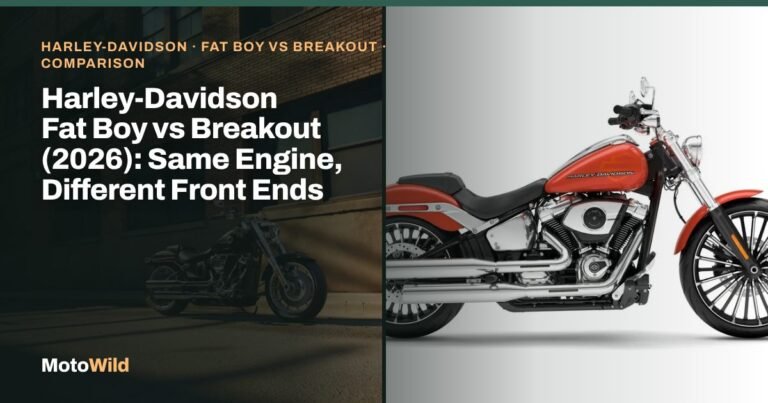 Harley-Davidson · CompareHarley-Davidson Fat Boy vs Breakout (2026): Same Engine, Different Front EndsBoth have the 117 Custom and a 240 rear. Rake, trail, front wheel size and wheelbase are where they differ, and the…Updated Oct 26, 2026
 Harley-Davidson · Compare2026 Harley-Davidson Cruisers Compared: All Eight Softails by the NumbersWeight, power, seat, tank, geometry, rpm at 70 mph and price for every 2026 Softail cruiser, with power-to-weight and chassis families.Updated Oct 26, 2026
 Harley-Davidson · GuidesMilwaukee-Eight 117 Classic vs Custom vs High Output: What ChangesSame bore, stroke and compression, three claimed outputs. What differs, which 2026 models get which, and what BMEP and piston speed say.Updated Oct 26, 2026
Breakout FAQ
What is the rake and trail of the 2026 Breakout?
34 degrees of rake and 5.7 in (145 mm) of trail, on a 66.7 in (1,694 mm) wheelbase, the longest in the cruiser range.
What tyre sizes does the Breakout use?
130/60B21 front and 240/40R18 rear, Michelin Scorcher 11.
How much fuel does the Breakout hold?
5 US gal (18.9 L), including about 1 gal (3.8 L) of reserve, according to dealer spec sheets.