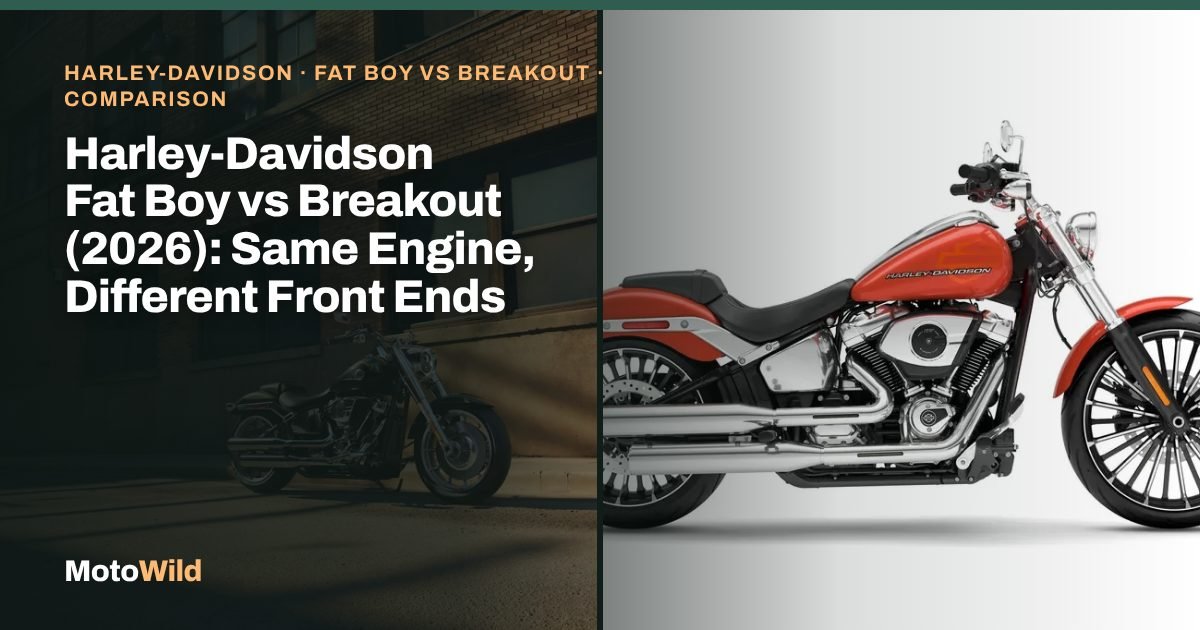
Harley-Davidson Fat Boy vs Breakout (2026): Same Engine, Different Front Ends
The Fat Boy and the Breakout are the two 2026 Softails with the Milwaukee-Eight 117 Custom, the same 240 mm rear tyre and almost the same price. Where they differ is the front end, and that changes how each one steers. This comparison sets out the published figures and works through what the geometry means. We have not ridden either bike for this piece; it is built on the specifications and sources listed at the end.
Quick answer
- Same engine and drivetrain: 117 Custom, 103 hp and 126 lb-ft claimed, six speeds, 32/66 belt.
- Different front ends: the Fat Boy has a 160/60R18 front tyre, 30° of rake and 4.1 in (104 mm) of trail; the Breakout a 130/60B21, 34° and 5.7 in (145 mm).
- The Breakout is longer: 66.7 in wheelbase against 65.0 in.
- Close on weight, seat and price: 681 lb vs 694 lb, 25.6 vs 25.9 in laden seat, $22,999 vs $22,599 starting MSRP.
Head-to-head · MotoWild data

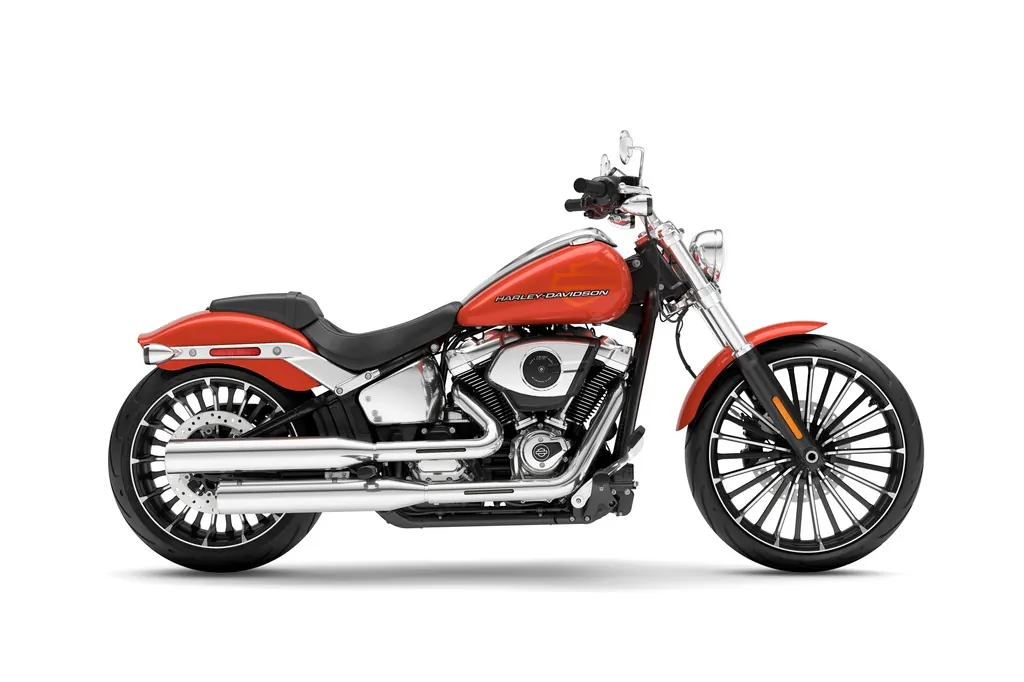
- Ready to ride, the 2026 Harley-Davidson Breakout is the lightest here, roughly 6 kg (13 lb) less than the 2026 Harley-Davidson Fat Boy. Makers weigh differently, so treat small gaps as a draw.
Seat height (laden, as published)
A range means sources disagree. Lower is easier at a stop, but weight and seat width matter too.
Weight, ready to ride
Figures as published, with their basis. Wet, kerb and full-tank weights are close but not identical, so a few kilos either way is a draw.
Fuel tank
| Spec | 2026 Harley-Davidson Fat Boy | 2026 Harley-Davidson Breakout |
|---|---|---|
| Engine | Milwaukee-Eight 117 Custom, 1,923 cc (117 cu in) 45° V-twin | Milwaukee-Eight 117 Custom, 1,923 cc (117 cu in) 45° V-twin |
| Power (claimed) | 103 hp (77 kW) at 4,800 rpm | 103 hp (77 kW) at 4,800 rpm |
| Torque (claimed) | 126 lb-ft (171 N·m) at 3,000 rpm | 126 lb-ft (171 N·m) at 3,000 rpm |
| Weight | 694 lb (315 kg) in running order | 681 lb (309 kg) in running order |
| Seat height | 25.9 in (658 mm) laden; 675 mm unladen | 25.6 in (650 mm) laden; 26.2 in (665 mm) unladen |
| Fuel tank | 5 US gal (18.9 L), including about 1 gal (3.8 L) reserve | 5 US gal (18.9 L), including about 1 gal (3.8 L) reserve |
| Rake / trail | 30° / 4.1 in (104 mm) | 34° / 5.7 in (145 mm) |
| Wheelbase | 65.0 in (1651 mm) | 66.7 in (1694 mm) |
| US price | $22,599 (starting MSRP) | $22,999 (starting MSRP) |
| Tyres | 160/60R18 / 240/40R18 Cast 18 / 18 in | 130/60B21 / 240/40R18 Cast 21 / 18 in |
Versions and model years
- Harley-Davidson Fat Boy: Fat Boys have used the Evolution, Twin Cam and Milwaukee-Eight engines since 1990. These figures are for the 2026 bike with the 117 Custom; check your model year before using them for parts or settings.
- Harley-Davidson Breakout: The Breakout returned for 2023 with the Milwaukee-Eight 117. Earlier Breakouts (Twin Cam engines from 2013, then the Milwaukee-Eight 107 or 114 from 2018) have different engines and figures. EU spec sheets list 168 Nm of torque; the US figure of 126 lb-ft (171 Nm) uses a different test method.
Figures: motorcycle.com · totalmotorcycle.com · torquepedia.com · harleydavidsonofsaltlakecity.com · harley-davidson.com · motorcycle.com · totalmotorcycle.com · aeharley.com · bartelsharley.com · harley-davidson.com · riders-share.com.
Geometry: why two bikes on one frame family steer so differently
Trail is the distance on the ground between where the steering axis meets the road and where the front tyre touches it. More trail makes a bike more stable and heavier to turn in; less makes it lighter. It depends on three things: rake, fork offset and the front wheel’s radius.
| Fat Boy | Breakout | |
|---|---|---|
| Rake | 30° | 34° |
| Trail | 4.1 in (104 mm) | 5.7 in (145 mm) |
| Wheelbase | 65.0 in (1,651 mm) | 66.7 in (1,694 mm) |
| Front tyre | 160/60R18 | 130/60B21 |
| Front tyre diameter (from size) | 649 mm (25.6 in) | 689 mm (27.1 in) |
| Effective fork offset (worked back from trail) | about 72 mm | about 73 mm |
The last two rows are calculated. Tyre diameter is rim diameter plus twice the sidewall (width × aspect ratio). The offset row solves the trail formula for offset using the published rake and trail, which shows something useful: the two bikes’ trail difference comes almost entirely from rake and wheel size, not from different triple clamps. Open the rake and trail calculator with the Fat Boy’s figures, then change the rake to 34 and the diameter to 689: trail jumps to about 145 mm, the Breakout’s figure.
What that means on the road, as a matter of geometry: the Breakout’s long rake, tall narrow front and long wheelbase favour straight-line stability; the Fat Boy’s shorter trail suits its wide, flat-profile front tyre, which on its own resists turning in. Reviews describe how each feels; the numbers explain why they differ.
Engine and gearing: identical
Both bikes have the 117 Custom with the same claimed 103 hp at 4,800 rpm and 126 lb-ft at 3,000 rpm, the same six-speed gearbox, 34/46 primary chain and 32/66 belt. Their rear tyres, 240/40R18, are the same size too, so road speed in each gear is the same. At 70 mph in 6th both turn about 2,570 rpm, worked out from the 2.79 overall ratio and the tyre size. The Fat Boy gear chart lists every gear.
Weight differs by 13 lb (681 lb Breakout, 694 lb Fat Boy, both in running order), which is about 2 percent: not something you would feel in acceleration. Power-to-weight is 6.6 lb per hp for the Breakout and 6.7 for the Fat Boy.
Tyres: what to check when replacing them
- Fat Boy: 160/60R18 front and 240/40R18 rear, both radials (the R in the size). Michelin Scorcher 11 from the factory.
- Breakout: 130/60B21 front (bias) and 240/40R18 rear (radial). Also Scorcher 11.
- Match the load index and speed rating on the sidewall, and keep the construction (bias or radial) the maker specifies for each end. The speedometer error calculator shows what a different rear size does to the speedometer.
Which one?
On the figures, this is a choice of front end and looks rather than performance. Choose the Breakout if you want the long, raked-out stance and the tallest, narrowest front wheel in the range. Choose the Fat Boy if you want the wide-tyred look, a slightly shorter bike and a lower starting price. Sit on both: the laden seat heights are within 0.3 in, but bar and peg positions differ.
FAQ
Do the Fat Boy and Breakout have the same engine?
Yes. Both have the Milwaukee-Eight 117 Custom, rated at 103 hp at 4,800 rpm and 126 lb-ft at 3,000 rpm in the US.
Which is heavier, the Fat Boy or the Breakout?
The Fat Boy: 694 lb (315 kg) in running order against 681 lb (309 kg) for the Breakout.
Why does the Fat Boy have less trail than the Breakout?
It has less rake (30° against 34°) and a smaller-diameter front wheel and tyre (an 18-inch 160/60 against a 21-inch 130/60). Both reduce trail.
Do they turn the same rpm on the highway?
Yes. Same gearing and the same 240/40R18 rear tyre: about 2,570 rpm at 70 mph in 6th, before tyre squash.
Sources
- Motorcycle.com, 2026 Fat Boy specs: motorcycle.com
- Total Motorcycle, 2026 Fat Boy (weight, rake, trail, 6th gear): totalmotorcycle.com
- Harley-Davidson of Salt Lake City, 2026 Fat Boy (tyres, seat, fuel): harleydavidsonofsaltlakecity.com
- Motorcycle.com, 2026 Breakout specs: motorcycle.com
- Total Motorcycle, 2026 Breakout: totalmotorcycle.com
- AE Harley-Davidson, 2026 Breakout (gear ratios): aeharley.com
- Riders Share, 2026 Harley-Davidson prices: riders-share.com
- Foale, T., Motorcycle Handling and Chassis Design (rake, trail and offset).


