Horsepower vs Torque in Superbikes — What the Numbers Really Mean
Every superbike buyer stares at the spec sheet. 212 hp. 113 Nm. 14,500 rpm redline. What do these numbers actually mean in the real world? How do you compare a 200 hp crossplane inline-four with a 215 hp V4? Why does a 200 hp Yamaha R1 sometimes feel faster than a 212 hp BMW M1000RR in real-world riding? This guide translates the numbers into something meaningful.
What Is Horsepower?
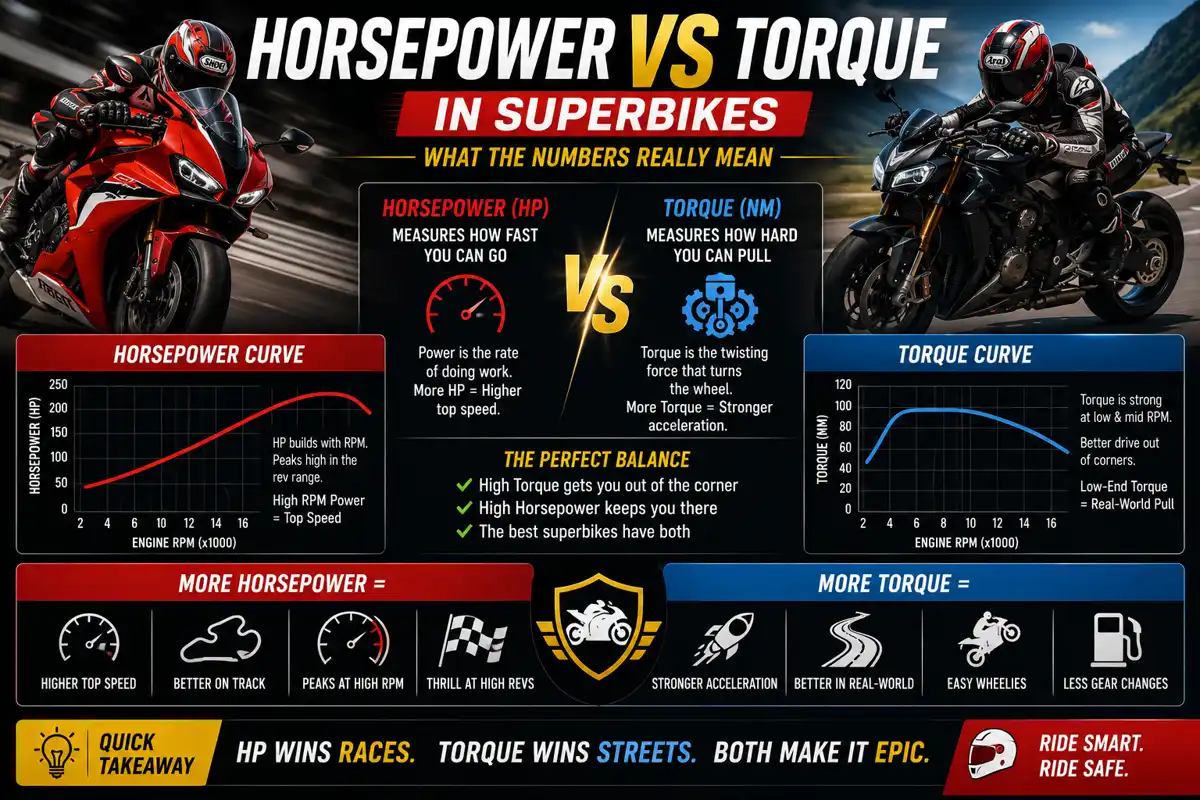
Horsepower (hp) is a measure of power — specifically, the rate at which work is done. In motorcycling, peak horsepower tells you the maximum rate at which the engine can deliver energy to the wheel. A higher horsepower figure generally means higher top speed and faster acceleration, but only tells part of the story. Critically, peak horsepower is achieved at a specific engine speed (rpm) — and that rpm is important.
A bike producing 200 hp at 13,000 rpm and a bike producing 200 hp at 14,500 rpm deliver the same peak power, but the first bike has a far wider usable power band because its peak arrives earlier in the rev range. In real-world riding where you are rarely at peak revs, the first bike will often feel faster.
What Is Torque?
Torque is a rotational force — it is what actually pushes you forward when you open the throttle. Torque is produced across the entire rev range, and the shape of the torque curve determines how a motorcycle feels to ride. A bike with strong low-to-mid range torque (like the Yamaha R1 with its crossplane crankshaft) feels easier to ride fast because power is available as soon as you open the throttle at any rpm. A bike with most of its torque in the top third of the rev range (like a traditional inline-four) rewards riders who keep the engine spinning hard but can feel flat at lower speeds
How Horsepower and Torque Relate
There is a direct mathematical relationship: Horsepower = (Torque × RPM) / 5,252 (for imperial units). This means that at any given rpm, if you know the torque, you can calculate the horsepower. At the rpm where the torque and horsepower lines cross on a dyno chart, torque equals 5,252 ft-lb — but in motorcycle terms, what matters practically is the area under the power curve, not just the peak figure.
Reading a Real Spec Sheet — A Worked Example
Let us use the BMW M1000RR as our example:
- 212 hp @ 14,500 rpm — Peak power at 14,500 rpm (very high in the rev range, requires effort to access)
- 113 Nm @ 11,000 rpm — Peak torque at 11,000 rpm (still high, but accessible earlier)
- Bore: 80mm, Stroke: 49.7mm — Wide bore, short stroke: classic high-revving design. More air/fuel per cycle, higher revs possible, less torque at low rpm
- Compression: 13.3:1 — Very high. Requires premium fuel, generates more heat, but increases power output
Compare this to a Yamaha MT-10 (a naked supernaked): 166 hp @ 11,500 rpm, 112 Nm @ 9,000 rpm. Lower power peak, but torque peak arrives earlier (9,000 vs 11,000 rpm). The MT-10 feels faster in everyday riding; the M1000RR is faster at the top of the rev range
Inline-4 vs V4 — The Engine Architecture Battle
The two dominant superbike engine configurations each have distinct characteristics:
Inline-Four (I4)
- Compact, narrow packaging
- Smooth power delivery, linear torque curve
- Strong top-end power when designed for high revs
- Used by: Yamaha R1, BMW S1000RR/M1000RR, Honda CBR1000RR-R, Kawasaki ZX-10R
V4
- Wider engine, different mass centralisation
- More torque across a wider rpm range due to firing interval
- Characterful, distinctive sound
- Used by: Ducati Panigale V4, Aprilia RSV4, Honda RC213V-derived
Neither is objectively superior — the V4 advantage in mid-range torque is real but subtle. The I4 advantage in top-end power delivery is equally real. The best superbikes of both types post near-identical lap times on a racetrack
Claimed vs Real-World Figures
Manufacturer power figures are usually measured at the crankshaft, not at the rear wheel. Drivetrain losses (gearbox, clutch, chain, sprockets) typically account for 12–18% of the crankshaft figure. So a claimed 212 hp BMW M1000RR delivers approximately 178–186 hp at the rear wheel — which is what matters for actual acceleration.
Independent dyno tests frequently show different results from claimed figures. The Ducati Panigale V4 (claimed 215.5 hp) regularly measures 175–180 hp at the wheel. The Yamaha R1 (claimed 200 hp) typically measures 165–172 hp at the wheel. This does not mean the manufacturers are dishonest — testing conditions, temperature, and methodology all affect the outcome.
What Specs Actually Matter Most?
If you want to understand a superbike’s real-world performance from its spec sheet, focus on these in order of practical importance:
- Power-to-weight ratio: Divide hp by weight in kg. 212 hp / 199 kg = 1.065 hp/kg. Higher is faster.
- Torque curve shape: Where does peak torque occur? Lower rpm = more accessible.
- Electronics package: Advanced TC/ABS lets you use more of the power safely.
- Weight: Below 200 kg is the benchmark. Every kg saved improves acceleration, braking, and handling.
- Peak power (last): Only relevant at full throttle near the rev limit. Rarest condition in real riding.
A lighter bike with 195 hp and excellent electronics will outperform a heavier bike with 215 hp and basic electronics in almost every real-world situation. Understand the whole picture, and you will make a far better buying decision.