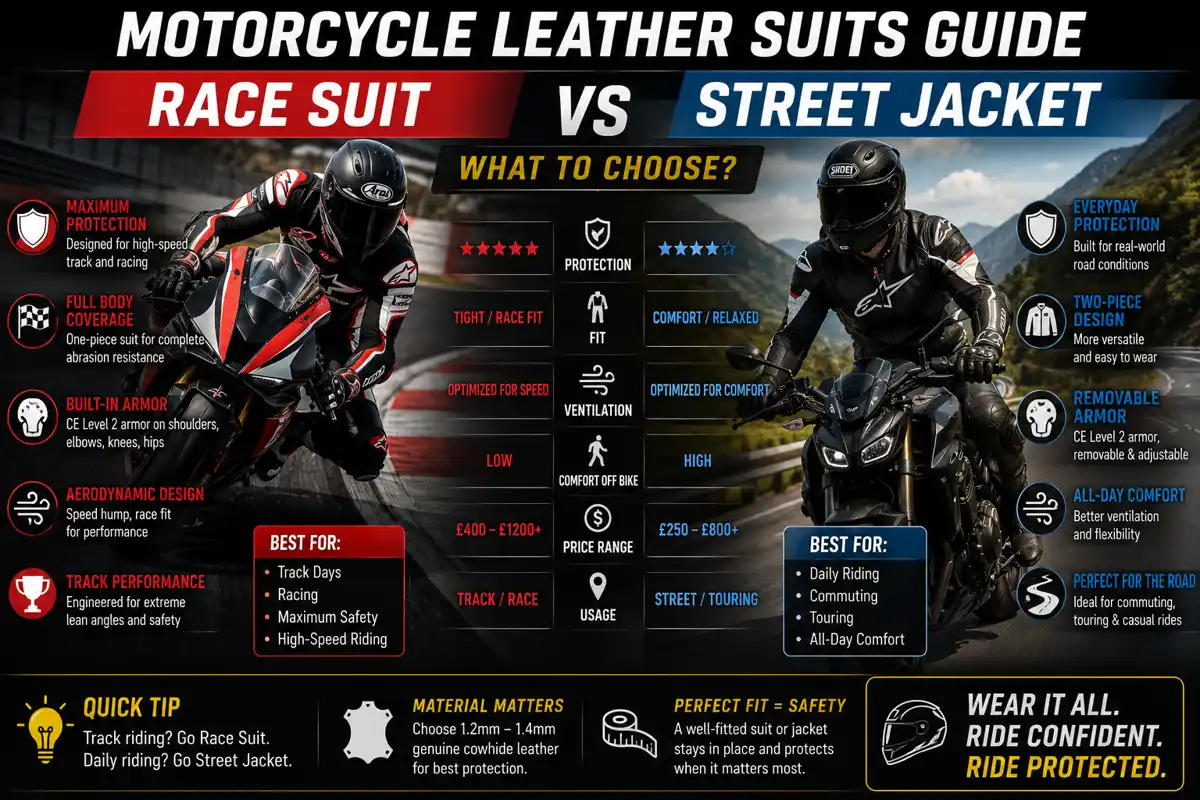
Motorcycle Leather Suits Guide — Race Suit vs Street Jacket, What to Choose
After your helmet, your riding suit is the most important safety item you own. The difference between a quality leather suit and cheaper alternatives is not just comfort — it is the difference between walking away from a crash and sustaining serious road rash and abrasion injuries. This guide covers everything you need to know about motorcycle leather suits in 2025, from materials and construction to the choice between a dedicated race suit and a street jacket.
Leather vs Textile — Which Is Better for Superbike Riders?
For superbike riders, leather is the preferred choice for the following reasons:
- Abrasion resistance: Full-grain cowhide leather offers superior slide resistance compared to textile alternatives. In a high-speed slide, leather outperforms even the best textile suit.
- Fit: Leather moulds to your body shape over time, creating a custom fit that improves both comfort and protection.
- Aerodynamics: A close-fitting leather suit creates less drag than a looser textile jacket, which matters at superbike speeds.
- Durability: Quality leather suits last 10+ years with proper care.
Textile suits have advantages for touring and commuting — better waterproofing, more pockets, and more comfortable in varied weather. For track days and spirited superbike riding, leather is the correct choice.
One-Piece vs Two-Piece Leather Suits
One-piece suits (also called race suits or leathers) offer maximum protection and the closest-fitting aerodynamic form. They are the choice for track days, circuit racing, and serious performance riding. The single-piece construction eliminates any gap between jacket and trousers at the lower back — the most vulnerable area in a crash. The downsides are practicality (you must wear the whole suit or none of it) and price.
Two-piece suits consist of a jacket and matching trousers with a zip connection. They offer more versatility — you can wear the jacket alone on short road rides — while still providing connected protection when zipped together. Quality two-piece suits with a sturdy 360-degree zip connection provide protection almost equal to a one-piece for road use.
CE Armour Ratings — What the Numbers Mean
European CE armour standards define the protection level of impact protectors fitted to suits:
- CE Level 1: Basic protection, suitable for road use. Most entry-level suits.
- CE Level 2: Higher impact absorption. Required for track use by most circuits. Noticeably bulkier but significantly more protective.
Check that your suit includes CE Level 1 or 2 protection in the shoulders, elbows, knees, and hips. Many suits are sold without back protectors — purchase a separate CE Level 2 back protector and fit it. The back is the most commonly injured area in motorcycle accidents and deserves the best protection you can provide.
Top Brand Recommendations
Alpinestars is the world’s most recognised motorcycle protective clothing brand, supplying suits to the majority of MotoGP riders. Their product range covers every price point:
- GP Force Lurv (entry track): ~£600 — excellent value with full CE Level 2 protection
- GP Pro R4 (mid-range): ~£900 — used by satellite MotoGP teams
- Supertech R10 (flagship): ~£2,000–£2,500 — factory race quality
Dainese — Italian Heritage and Innovation
Dainese invented the back protector and holds numerous patents in motorcycle safety innovation. Their suits are particularly well-regarded for their composite shoulder and elbow protectors, which offer exceptional protection at low weight. Highlights:
- Laguna Seca 5 (track): ~£750 — best value Dainese track suit
- Misano 3 D-Air (airbag): ~£1,500 — integrated airbag technology
- D-Air Racing Coverall (flagship): ~£3,000+ — MotoGP level airbag suit
RST — Best Value British Brand
For riders on tighter budgets, RST (UK) produce quality leather suits at significantly lower prices than the premium brands while still maintaining good CE certification. The RST Pro Series 1 one-piece suit provides genuine track-day protection at approximately £300–£400 — exceptional value for the price.
Care & Maintenance of Leather Suits
A quality leather suit properly cared for will last a decade or more. Here is how to maintain it:
- After every wet ride: allow to dry naturally, never use direct heat (hair dryer, radiator)
- Monthly: Apply a leather conditioner (Nikwax Leather Conditioner or Saddleman) to prevent cracking
- Annually: Have the suit inspected by the manufacturer or a professional — they can identify stitching wear, armour degradation, and leather fatigue before they become safety issues
- After a crash: Replace the suit regardless of how it looks — internal armour and leather that has absorbed impact energy is no longer fully protective
- Storage: Hang the suit on a padded hanger, never fold it (folding causes permanent creases and leather fatigue)
Summary — Our Recommendation
For most superbike riders who do track days 2–4 times per year and road ride the rest of the time, the ideal choice is a two-piece leather suit at CE Level 2, from Alpinestars or Dainese in the £600–£1,000 range. Add a separate CE Level 2 back protector if not included. This gives you versatility for road use, genuine track protection, and durability that justifies the investment. If you race or track day more than 6 times per year, step up to a one-piece race suit from the GP Force or Laguna Seca range.