Honda Fireblade SP vs Yamaha R1M — Ultimate Track Day Shootout
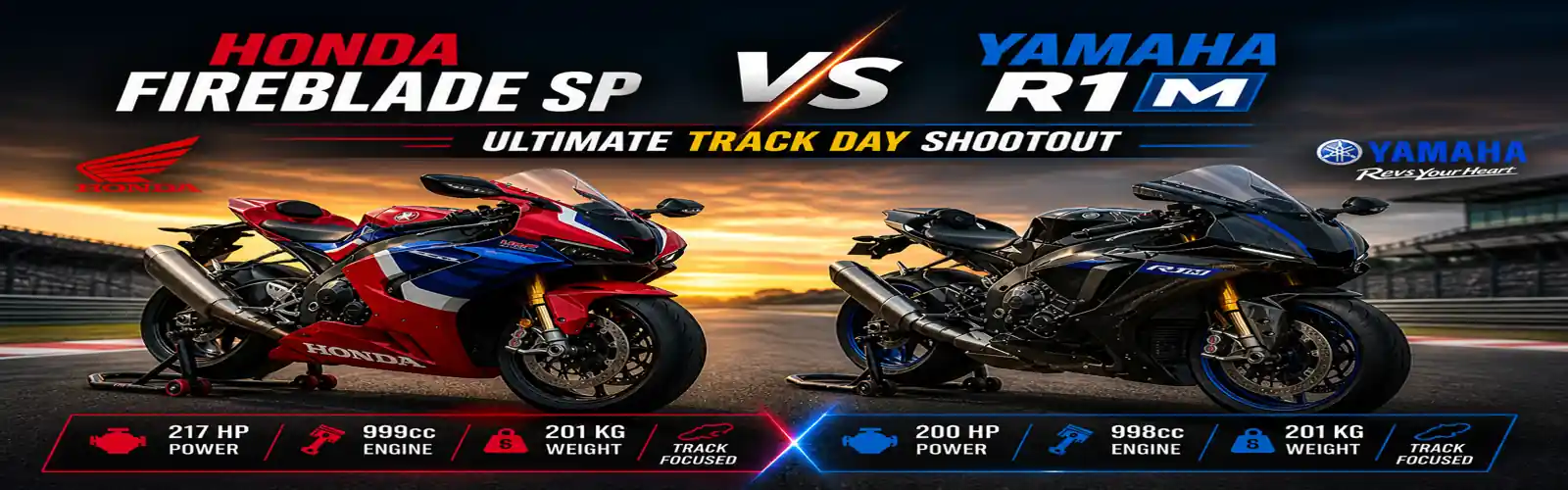
Honda versus Yamaha. Two Japanese giants. Two decades of rivalry. In 2026 both companies have produced their finest-ever litre-class superbikes, and deciding between them is genuinely difficult. The Honda CBR1000RR-R Fireblade SP draws directly from Honda’s MotoGP RC213V. The Yamaha R1M features a crossplane inline-four and the world’s most advanced IMU-based electronics. Both are exceptional. Here is how they compare.
Heritage — Racing DNA on Both Sides
The Fireblade name has existed since 1992, and every iteration has been built around Honda’s ‘Total Control’ philosophy — the ideal balance of power, weight, and handling. The 2026 version is the most ambitious yet, developed with direct input from the RC213V-S MotoGP-derived project. The Yamaha R1 lineage dates to 1998 and introduced the world to the concept of crossplane crankshaft technology in a production motorcycle — a layout that gives the engine a distinctly different power character to a traditional inline-four.
Engine Comparison
The Honda’s 999cc inline-four produces 217 hp at 14,500 rpm, making it one of the most powerful naturally-aspirated inline-fours in production. The engine is extraordinarily free-revving, with a top-end rush from 10,000 rpm to the 14,500 rpm redline that is breathtaking. The Yamaha R1M produces 200 hp, slightly less on paper, but the crossplane crank gives the engine a V4-like torque character with strong mid-range grunt — making it feel faster in real-world riding conditions where you are not always at the top of the rev range
Electronics — Yamaha’s IMU Advantage
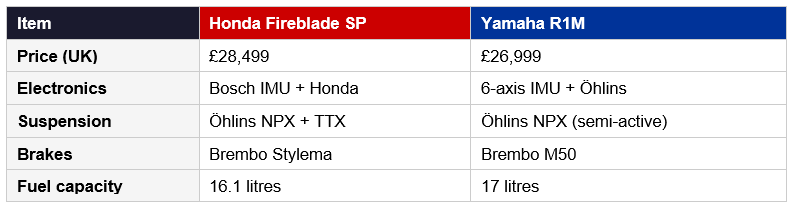
Both bikes feature world-class electronics, but the Yamaha R1M holds an advantage. Its 6-axis IMU provides cornering traction control, cornering ABS, and slide control that is among the most sophisticated available on any production bike. The Öhlins NPX electronic suspension fitted as standard on the M model is also exceptional. The Honda’s Bosch IMU-based system is excellent, but the Yamaha’s overall electronics package — particularly the Öhlins semi-active suspension — edges ahead.
Handling — Different Characters, Equal Results
The Honda feels lighter and more nimble — at 201 kg wet it is marginally lighter than the R1M at 202 kg. The steering is more direct, the feedback through the bars is exceptional, and the Brembo Stylema brakes provide confident, powerful stopping. The Yamaha is slightly more planted in direction changes, benefiting from the flywheel effect of the crossplane crankshaft, which reduces unloading of the rear tyre at corner entry. Both are confidence-inspiring in the hands of an experienced rider.
Price Comparison
Final Buying Recommendation
Buy the Honda Fireblade SP if: you prioritise raw top-end power, the most advanced Honda MotoGP-derived technology, and a bike that rewards aggressive riding with an emotional, high-revving payoff. The Honda is the purer sporting machine.
Buy the Yamaha R1M if: you want the most advanced electronics package on the market, semi-active suspension as standard, a more usable mid-range power delivery, and a bike that is slightly more forgiving at the limit while still being devastatingly fast.
- Better for pure track: Honda Fireblade SP ✓
- Better electronics: Yamaha R1M ✓
- Better for road + track: Yamaha R1M ✓
- More exciting engine: Honda Fireblade SP ✓
- Overall pick for most riders: Yamaha R1M 🏆